
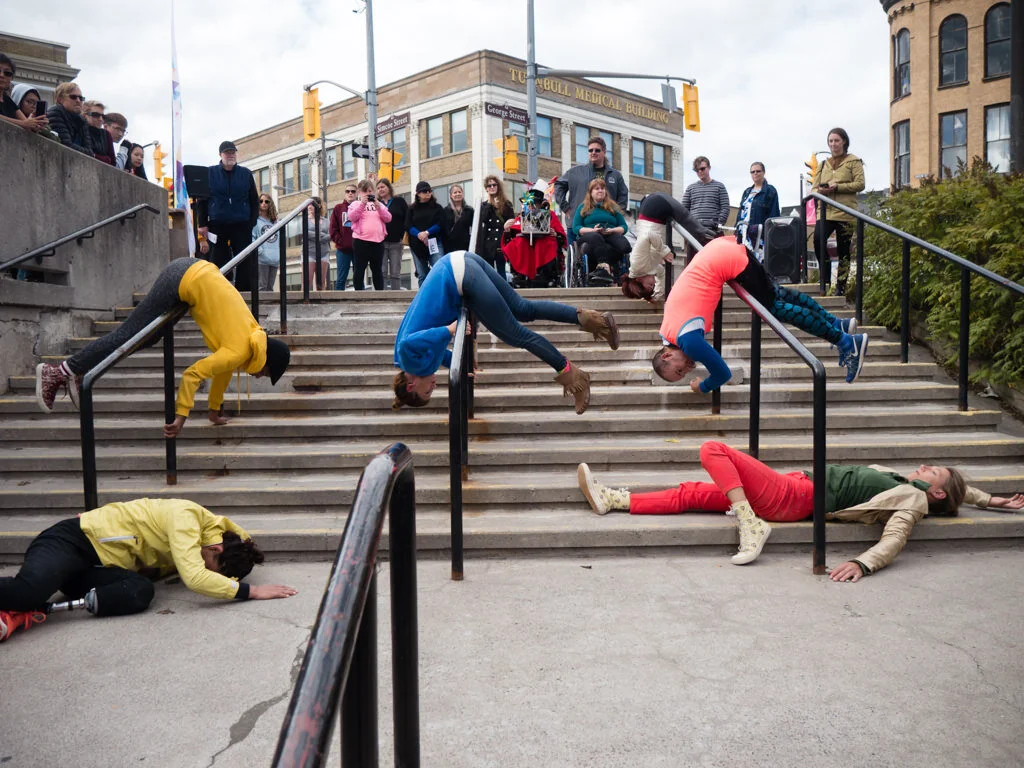
Ephemeral Artifacts: Brandy Leary in conversation with Coman Poon
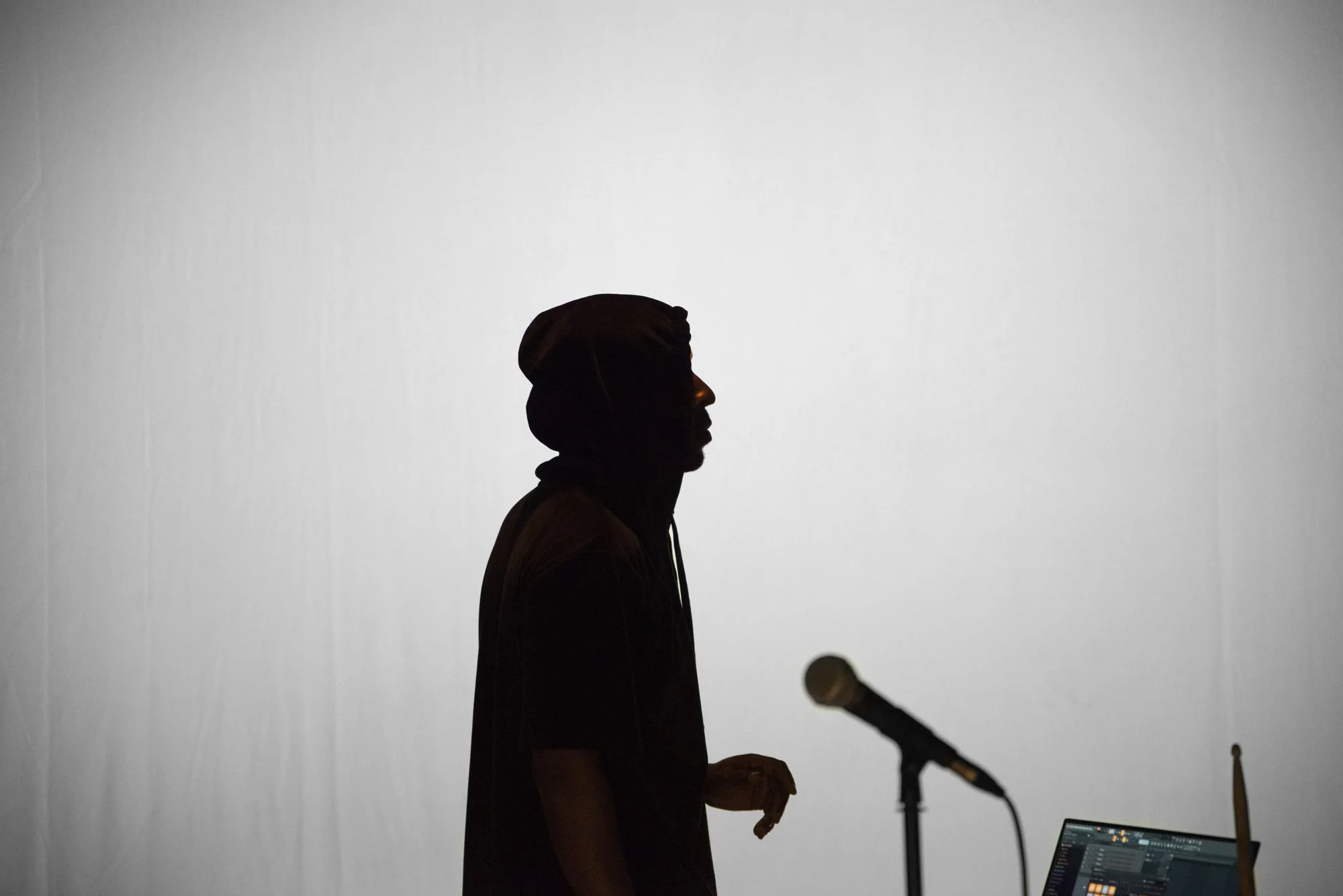
Photo of Travis Knights by Eamon Mac Mahon
Below is an excerpt from my July 1, 2021 conversation with Brandy Leary, Artistic Director and Founder of Anandam:
Coman: I was writing some notes to myself in preparation for this conversation, thinking about the iterative nature of your choreographic works. Part of my entry point for designing this conversation was examining Ephemeral Artifacts as repertoire. It is a work that you have been creating and presenting since 2017, with multiple artists in works of different scales and in diverse contexts. Externally it can appear different each time, depending on the artists you are working with, but the choreographic framework remains while the artistic investigation evolves. It's a presence-ing of lineage (form), a presence-ing of transgenerational knowledge (time) that maintains a relationship to lines of inquiry (context) and also lines of accumulation and proliferation (body). At the same time it expresses an ethic of collaboration which is another structure/system contained in the choreography of co-creation. One that is not actually so visible to a participant-witness at the end product but nonetheless it is conscious and insistently choreographic.
Brandy: Yes. You are correct in what you said earlier about the iterative nature of my works consciously troubling established notions of repertoire. I am being really specific in calling Ephemeral Artifacts repertoire. It often feels, to me at least, that there exists a tendency to reduce the complexity contained in alternative methodologies for dance making. This work often gets reduced to a solo tap show in description or conversation. However it is a piece that began in 2017, has had multiple iterations in different contexts; gallery, public space, architecture, theatre and the contributions of about 20 artists across the years.
I’m realizing that Ephemeral Artifacts, along with other repertoire works of Anandam (Glaciology, Divergent Dances, Cascade, Melting/Mourning), contributes to understanding choreography as a practice, where it becomes emancipated from singular forms. A practice that moves towards a structural understanding of dance creation that prioritizes the body as the main place of inquiry. It's a nuanced approach, prioritizing the body over the more loaded centering of a (dance) form. It’s not negating form, but looks to bring deeper attention to what a body is actually doing in space and time that is specific to each artist involved in the project. One can think of it as understanding that choreography is also a form, one that is not always tied to a particular genre of dance once the body becomes the central site of inquiry.
Ephemeral Artifacts works through a structure that allows the performer to have autonomy - this piece is very much about one’s relationship to form and highlights questions examining form, its content and context. The choreographic inquiry is grounded in the body, examining how knowledge gained through the practice of dance is relational; accumulating through time within a form. Dance traditions do not magically appear. Nor are they frozen ancient events unchanged or unresponsive to time and history. Rather, dances and specific techniques for dancing have been developed, researched and evolved by hundreds (if not thousands) of bodies (and communities) over time. This perspective understands the body as an evolving process, not a singular or fixed image. That is important for me as a choreographer.
Coman: How does that contribute to expanding contemporary approaches in choreography?
Brandy: Well, generally we think of choreography as repeatable in some way. Particularly when we have a presenter-centred dance ecology that wants to know what a work is, which is fair. Because of Ephemerals’ structure, it looks very different for each performance or from iteration to iteration. Ephemeral Artifacts works through a framing structure of questions to create a choreographic matrix. These questions are parameters for the body; its relationship to practice and repetition, history, work. The choreography is responsive. This requires a presenter that deeply trusts both the artists and the work. It’s a big ask, I understand. It does not offer an easy marketing strategy.
But somehow I like that it is not easy. Because the material is not easy. It does not assume an understanding of dancing. Nor does it approach dancing through compulsive tropes citing ritual, ancientness or generic universal claims. It is a work that examines the body over time with rigorous specificity. Maybe it shares some things in common with the visual art idea of the readymade? One might think tap dance is a certain way or have a preconceived image. This work offers context that pushes against assumptions. It is an unapologetic invitation to expand an audience's perception and experience. This can be uncomfortable.
Coman: I wanted to share with you something about structuralism that I think you might be very interested in. I’m not an architect, but I live with and am married to one, so it is always part of our conversations at home. I was thinking about this definition: “structuralism is a theoretical paradigm emphasizing that elements of culture must be understood in terms of their relationship to a longer overarching system or structure.” I feel like that speaks directly to your practice, to the iterations of Ephemeral Artifacts that I’ve witnessed and to how you reposition choreography. It points to how there is a relationship, or interactions, within social and built structures - which I notice in Anandams’ artistic and sectoral ruptures. Aldo Van Eyck (who is my partner’s hero and former teacher - he built a very interesting house in Vreeland in the Netherlands where he brought the indoors out and the outdoors in, by troubling interstitial space. I wanted to show you a little bit of his way of thinking. (shows photo)
See the entrance here? He pushed out the envelope of the built form and covered it in glass. Then punctured inside the actual structure to create an exterior space, inside the building itself. For me, it’s just a small example of a way of thinking of how to physically manifest the idea of inter-relations.
Brandy: And permeability.
Coman: Permeability…and interdependence.
Brandy: Also, an invitation to conceive and actualize structures… not as barriers, but as forms of experimentation, of thinking. Generative spaces for the imagination and for bodies.
Coman: You work with the body and with the transversality of culture in this way as well. So, this is where I think both in terms of the process of collaboration, but also what is seen and heard, felt or intuited, or in other ways sensed or beyond sensible in any moment of making and experiencing dance. It is what one teacher described to me as the notion of qualia. Which I had never heard of before. In essence, it’s the subjective experience of qualities of what we are connected to or embodying.
Brandy: It feels like an expansive way to speak of a relationship to the sublime. To something larger than ourselves, something I try to understand through dancing.
For me, as a choreographer, this relates to quietude. It is something I consciously use in my works. Not in a literal or explicit way, but somehow I find strength in quietness. I find clarity and nuance. A quietness that contains space. Space that does not demand immediate responses but encourages the experience of time to be a tangible part of the encounter. I try to create dances that allow for lingering attention. This is also how I relate to the world. It will always influence how I make choreography.
Art humanizes by allowing us complex explorations of being human. Through it we connect to things that are common and also vast. It's that paradox that creates the tension necessary for dancing. To me, this is different from a blanket claim that art is universal. Yes, there are universal experiences; of loss, joy, pain, vulnerability, ecstasy and much more. But what makes these shared experiences across artistic practices fascinating is the variation of interpretation. This occurs because different aesthetic models codify and signify these expressions structurally. A cathartic model descending from europe expresses despair very differently than a rasa model from south asia, or perhaps a call and response model that can be found in north american jazz. I am being a bit colloquial with these groupings as there are many diverse and established models across the world. The audiences of these art forms carry and understand these different codes. That is also part of transmission occurring through bodies, between artists and audiences. The experiences of being human may be universal but the artistic treatment of that experience is vast, specific and codified. There is not one homogeneous expression of a universal.